
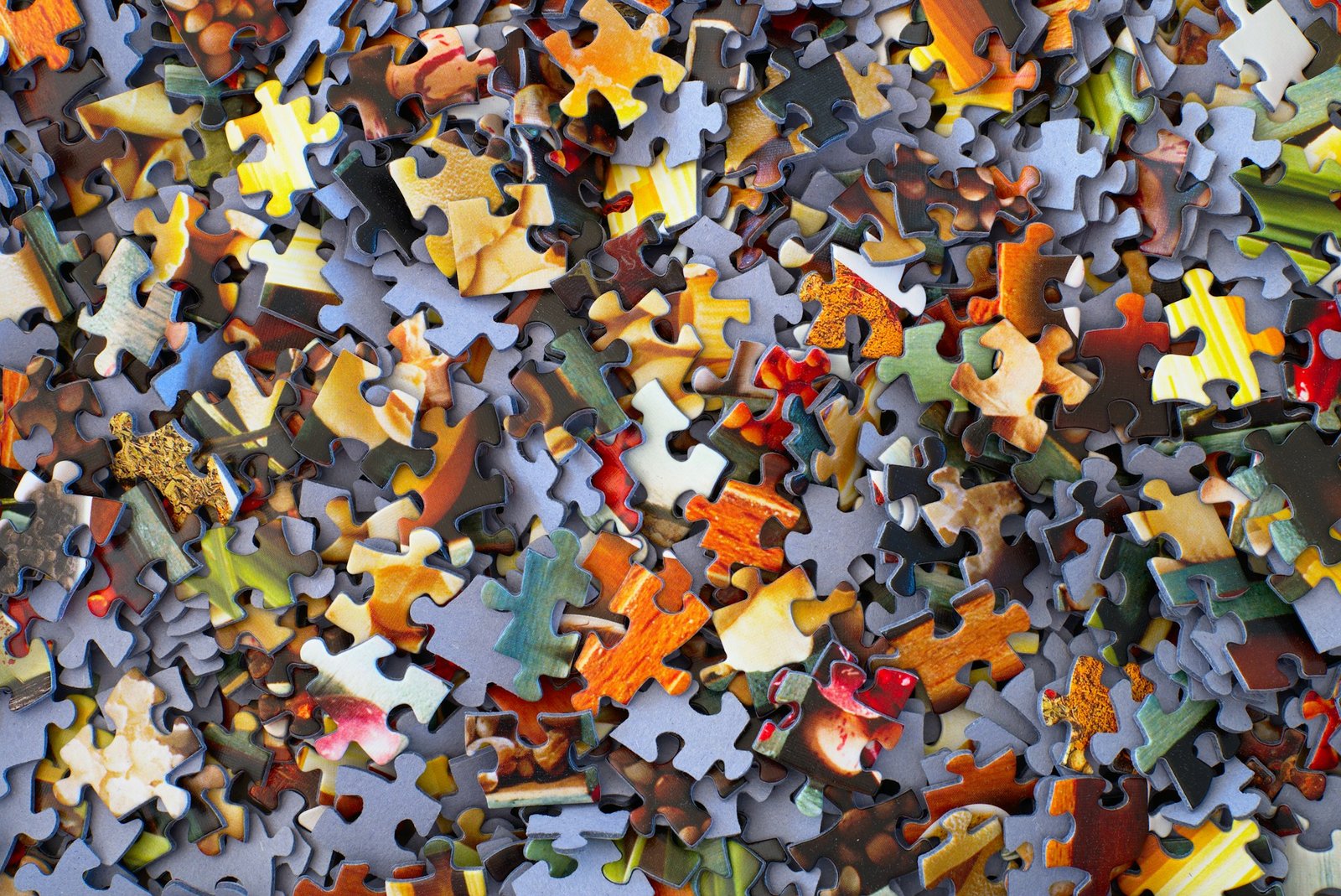
Most people assume a puzzle is a puzzle. Tip the pieces onto the table, find the corners, work inward, done. But the gap between finishing a flat 1,000-piece jigsaw and assembling a three-dimensional architectural model is wider than it first looks. Both formats test your brain, just in completely different ways. If you’re deciding which format suits your skill level, buying a gift, or hunting for something genuinely more demanding than your last jigsaw, knowing exactly where each type pushes you hardest is worth figuring out before you commit.
The Challenge of Traditional Flat Puzzles
Traditional puzzles operate on a deceptively constrained set of rules: every piece is flat, the image is fixed, and the finished shape is always a rectangle. Collectors who gravitate toward hands-on construction often find that 3D puzzles for collectors demand a different kind of thinking compared to flat jigsaws – though that doesn’t mean traditional formats are easy. Difficulty scales sharply with piece count, image complexity, and the manufacturer’s cut pattern. A 500-piece puzzle with bold, high-contrast imagery is a relaxing afternoon; a 2,000-piece puzzle printed entirely in muted, near-identical sky tones can genuinely exhaust experienced solvers. The flat format keeps all visual information on one plane, which is both its limitation and its particular brand of cruelty – you can see every piece, but telling one pale-blue fragment apart from ninety nearly identical ones demands sustained concentration and a strong visual memory.
Pattern Recognition and Visual Memory
The core cognitive demand of a traditional puzzle is visual discrimination, noticing tiny differences in colour, grain, texture, and shape across dozens or hundreds of similar pieces. Experienced solvers develop a systematic approach: sort by colour family first, then by edge detail, then by the presence of a specific line or tonal shift. But even with a solid system in place, the actual work happens in your visual cortex. You compare, reject, rotate, and retest each piece against its neighbours, over and over. Research published in 2019 by the University of Exeter’s medical school found that regular puzzle activity is associated with sharper short-term memory and stronger attention to detail in adults over 50. That finding makes intuitive sense to anyone who’s spent two hours hunting for a single missing mid-sky piece. Traditional puzzles don’t ask you to think in three dimensions, but they do demand a kind of patient, methodical visual intelligence that shouldn’t be underestimated.
Piece Count, Cut Patterns, and Difficulty
Manufacturers control difficulty through two main levers: piece count and cut pattern. A random-cut puzzle – where every piece shape is unique – is considerably harder than a grid-cut version, because grid-cut pieces share a limited set of shapes that makes sorting faster. Beyond that, image choice matters enormously. Puzzles with repetitive patterns, low contrast, or deliberately confusing artwork (think M.C. Escher prints or gradient colour washes) strip away the visual landmarks most solvers rely on. Some makers also produce double-sided puzzles or intentionally misprint boxes so the image guide is wrong. These techniques don’t change the flat-plane nature of the challenge, but they reveal just how heavily traditional puzzle difficulty depends on the manufacturer’s choices rather than the solver’s spatial ability. The cognitive load is real; it’s just narrowly visual rather than spatial or structural.
What Makes 3D Puzzles Genuinely Harder
Where a traditional puzzle keeps everything on one plane, a 3D puzzle distributes elements across three dimensions at once. You aren’t just matching colours and shapes, you’re building a structure that must hold its own weight, maintain correct proportions, and come together in a specific sequence. Miss a step in a flat jigsaw and you’ll notice almost immediately when pieces stop fitting. Miss a step in a 3D build and the error might not surface until ten layers later, when the structure leans, gaps open up, or the final section simply won’t lock into place. That structural accountability is what separates the two formats most clearly.
Spatial Reasoning and Assembly Sequence
The dominant skill in 3D puzzle assembly is spatial reasoning – the ability to mentally rotate and position a piece before you physically place it. Pieces in a 3D kit are often identical in shape but must go in a specific orientation at a specific point in the build sequence. And here’s the thing: unlike a flat puzzle, where you can skip around the image and return to a tricky area later, many 3D kits require strict sequential assembly because earlier layers form the foundation for everything above them. Get the base wrong and the upper sections won’t align. A 2020 study from the University of Chicago found that spatial reasoning tasks – including construction activities, activate the parietal lobe more intensely than two-dimensional visual matching does, which suggests 3D assembly genuinely draws on a different cognitive system. You can’t compensate with patience and a good eye alone; you need to think structurally.
Stability, Load-Bearing Logic, and Error Recovery
Traditional puzzles are forgiving. A misplaced piece is obvious immediately, and fixing it takes seconds. 3D puzzles aren’t forgiving in the same way – structural errors compound; a slightly misaligned base piece increases stress on every connecting piece above it, and by the time the flaw becomes visible, you may need to disassemble a large portion of the build to correct it. Some 3D kits, particularly those modelling real architecture or vehicles, require you to apply load-bearing logic: which sections need to interlock before others, where structural pressure concentrates, and how to seat curved or angled components without cracking the material. Foam-core and polystyrene kits are especially unforgiving because the pieces can only flex a limited number of times before they weaken. So error recovery in a 3D puzzle isn’t just about finding the right piece – it’s about diagnosing where the build went wrong before the damage becomes irreversible.
Conclusion
Both formats are genuinely challenging, but in distinct ways. Traditional flat puzzles test visual discrimination, pattern recognition, and sustained attention – skills that get sharper the higher the piece count and the more punishing the image. 3D puzzles shift the challenge toward spatial reasoning, sequential thinking, and structural awareness, with far less room to recover from mistakes. If raw cognitive difficulty across more brain systems is what you’re after, 3D puzzles have the edge. But if you’d rather have a slower, more meditative experience that rewards patience above almost everything else, a high-quality flat jigsaw is no easy substitute. Honestly, neither format is universally harder – the right question is which type of thinking you find more demanding.
